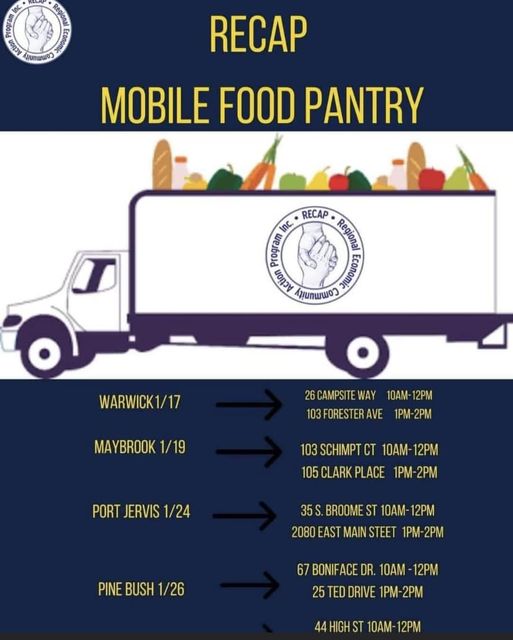
Image


A Repair Cafe is a free community event to bring your broken but beloved items together with volunteer repair coaches. Items are repaired for FREE! Learn more about items and locations click the link below.

Story Time at the Pine Bush Library
TODDLER TIME
WITH MISS LUCY
(Ages 2 – 3 years with adult)
MONDAYS
January 23rd & 30th
10:30 AM
PRESCHOOL STORYTIME
WITH MISS CHRISSY
(Ages 3 – 5 years with adult)
WEDNESDAYS
January 18th & 25th
10:30 AM
YOU MUST BE REGISTERED IN ADVANCE FOR ALL STORYTIME EVENTS, AS SPACE IS LIMITED INDOORS!!!
PLEASE, NO DROP-INS!
845-744-3375 ext.3
IF YOU CANNOT MAKE IT AFTER REGISTRATION, PLEASE CALL TO LET US KNOW!
PLEASE DO NOT ATTEND IF YOUR CHILD HAS A FEVER,
COUGH OR RUNNY NOSE!!!!!!

Fast Facts about Martin Luther King, Jr.
Here’s a look at Martin Luther King Jr. Day, a federal holiday that falls on the third Monday in January.
January 16, 2023 – Martin Luther King Jr. Day.
King’s actual birthday was on January 15.
Timeline
April 8, 1968 – Rep. John Conyers (D-MI) introduces legislation for a federal holiday to commemorate King, just four days after his assassination.
January 15, 1969 – The Martin Luther King Jr. Memorial Center in Atlanta sponsors and observes the first annual celebration of King’s birthday.
April 1971 – The Southern Christian Leadership Conference (SCLC) presents to Congress petitions containing three million signatures in support of the holiday. Congress does not act.
1973 – Illinois is the first state to adopt Martin Luther King Jr. Day as a state holiday.
November 4, 1978 – The National Council of Churches urges Congress to enact the holiday.
1979 – Coretta Scott King speaks before Congress and joint hearings of Congress in a campaign to pass a holiday bill. A petition for the bill receives 300,000 signatures, and President Jimmy Carter supports passage of a bill.
November 1979 – The House fails to pass Conyers’ King Holiday bill by five votes.
1982 – Coretta Scott King and Stevie Wonder bring the speaker of the House, Tip O’Neill, petitions with more than six million signatures in favor of a holiday.
1983 – Congress passes and President Ronald Reagan signs legislation creating Martin Luther King Jr. Day as a national holiday. Senators Jesse Helms (R-NC) and Gordon Humphrey (R-NH) attempt to block the bill’s passing.
January 20, 1986 – First national celebration of the Dr. Martin Luther King Jr. holiday takes place.
January 16, 1989 – The King holiday is legal in 44 states.
1994 – Coretta Scott King goes before Congress and quotes King from his 1968 sermon, “The Drum Major Instinct,” in which he said, “Everybody can be great because everybody can serve.” She requests that the holiday be an official national day of humanitarian service.
1994 – Congress designates the holiday as a national day of service through the Martin Luther King Jr. Federal Holiday and Service Act.
1999 – New Hampshire becomes the last state to adopt a holiday honoring King.
January 17, 2011 – Marks the 25th anniversary of the holiday.
December 15, 2021 – The family of King calls for “no celebration” of MLK Day without the passage of voting rights legislation.

The Town of Crawford is always looking for volunteers for the Friendly Visitors Program. This program links volunteers in the town with those in need!
For additional information, please visit townofcrawford.org or call 845-745-0503.

Our latest newsletter has been published!
If you would like to see it click the link below
If you would like a copy of our newsletter delivered directly to your inbox send us an email PBL@rcls.org, message us here on Facebook or sign up in person when you visit.


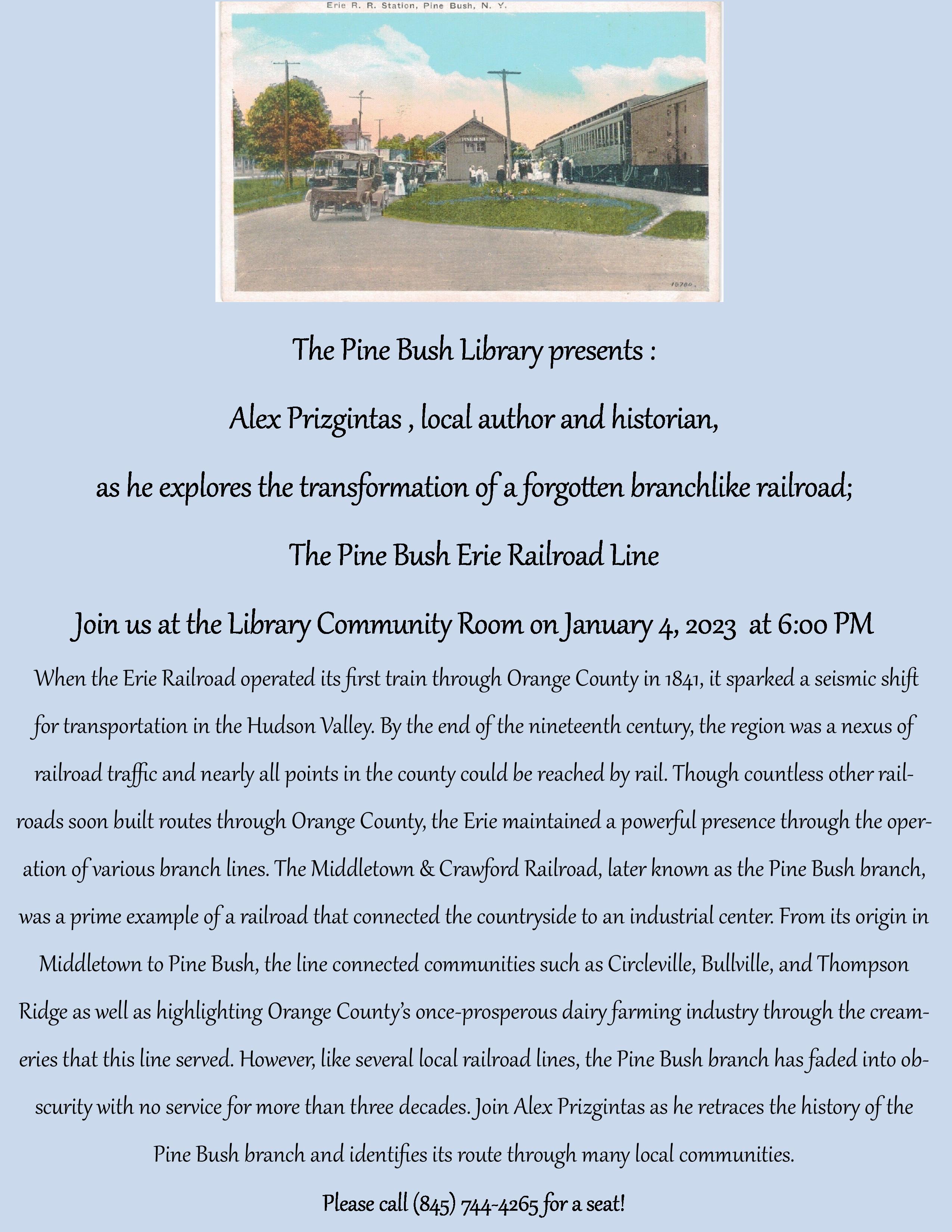
Join local author and historian Alex Prizgintas as he explores the transformation of a forgotten Orange County branchlike railway.
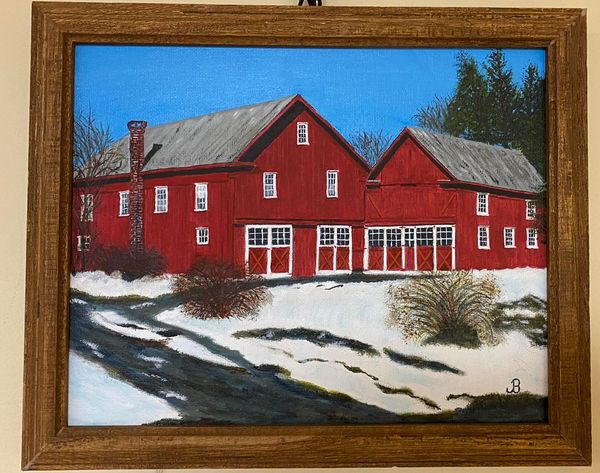
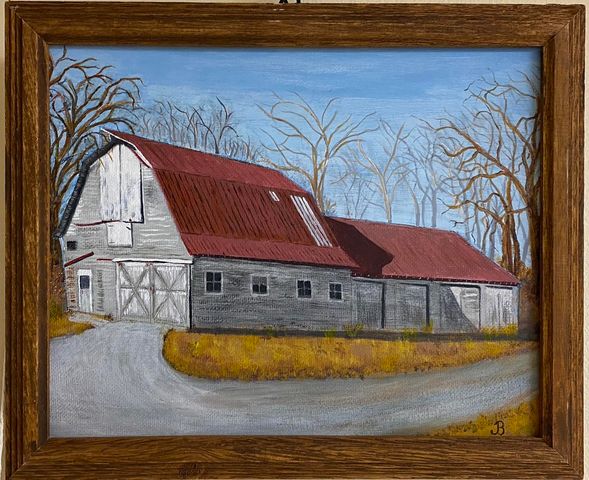
Jack has been kind enough to display an impressive collection of his paintings in the main library for the month of January. If you would like to see Jack’s paintings stop by the main library and look up.
Artist – Jack Broomhead
I first became interested in art when I was about six or seven years old, when I received a Jon Gnagy’s “learn to Draw” as a Christmas gift. I would sit by my window and try to draw the houses on the distant hills. When I was a bit older, I like to stand back and observe the detail in drawings and paintings.
Perhaps this is why when I now paint barns and other objects; I try to add as much detail as I can. It is my intent to create depth in artwork as I look into a painting. I am a member of the Wallkill River Center for the Arts located in Montgomery, NY. I participate in the “Senior Drop In” group which I joined about four years ago. That is when I started to paint local barns. In my opinion, there are barns in our area that have a lot of character. I try to portray that in my paintings.
These thirty barns are a small fraction of those available to paint. Our barns are disappearing so I am trying to preserve them through my paintings. Aside from barns, I enjoy painting local birds and landscapes. An inspiration for my landscape is the American works of the Hudson River School artists.
I hope you enjoy viewing a portion of my work and recognize some of the many barns that still grace our surrounding area.



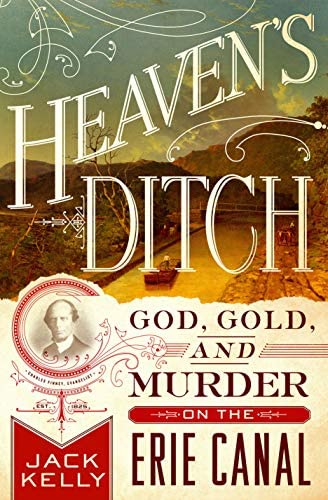
Before there were railroads, or interstate highways with massive trucks; flour and other foods, and manufactured goods had a hard time getting to the customers. Western New York State was crammed with all sorts of good things, and they were not going anywhere. In the 1700s and early 1800s, the roads were hopeless quagmires.
Then various people thought of canals. It became a dream to make a canal that would run from Buffalo to Albany. After that, Rochester’s flour (from the Flour City) could be sent down the Hudson River to the markets in New York City. And, once you were on the Great Lakes, you could go the other way and take your goods to the Midwest. Jack Kelly’s book, Heaven’s Ditch discusses this and more. The subtitle is God, Gold, and Murder on the Erie Canal. DeWitt Clinton and others made the Erie Canal. Find this book in the adult non-fiction section, in the Pine Bush Area Public Library.
New York Governor DeWitt Clinton had the first section of the Erie Canal dug on July 4, 1817, in Rome, NY. From there it went west and east to connect Buffalo and Albany, going through the Montezuma Swamp, despite the malaria. It was a massive undertaking, and Irish laborers and others dug the canal by hand.
The book is about more than digging in the mud. It is about religions that sprang up as the canal opened up a region of Upstate. There is a brief reference to Jemima Wilkinson, “the Public Universal Friend” near Seneca Lake. There is a lot said about Joseph Smith in Palmyra. He discovered the golden plates on Hill Cumorah, and founded the Church of the Latter-Day Saints (Mormonism.) Charles Finney led religious revivals that were wildly popular. William Miller founded Millerism, which expected the end of the world, in 1844. (He was disappointed.) William Morgan joined the Freemasons but later wrote a book telling the secrets of that organization. Shortly afterwards, he was bundled, screaming, into a carriage and disappeared.
The book covers a lot of diverse topics. There was the problem of strong drink, and it really was strong, when people drank whisky instead of water, because water was not safe. There was the topic of money-digging, or treasure hunts, where the looking was more important than the finding. And speaking of digging, there were the ins and outs of how to build a canal across an entire state.
The chapters are divided into sub-chapters and I get confused as the book bobs from one subject to another. If you are interested in the religions and religious revivals of the 1800s, or interested just in Upstate New York, this is the book for you. If you want to know more about the seething life that ran along the area of the Erie Canal, read Heaven’s Ditch.
“I’ve got a mule and her name is Sal. Fifteen miles on the Erie Canal. She’s a good old worker and a good old pal. Fifteen miles on the Erie Canal…And you’ll always know your neighbor, You’ll always know your pal, if you ever navigated on the Erie Canal.”
The staff of the Pine Bush Library would like to wish everyone a happy, safe and prosperous new year filled with MANY MANY books.

 Pine Bush Area Public Library
You must be logged in to post a comment.